
Managed instability: The Iran conflict and the degradation of economic coordination
Abstract
The ongoing conflict involving Iran is widely interpreted through the lens of energy disruption and geopolitical escalation. This framing, while directionally relevant, remains analytically incomplete.
What is emerging is not primarily a breakdown of supply, but a transformation in how supply is accessed, priced, and coordinated under stress. Energy continues to flow, but under increasingly constrained and conditional access. Markets continue to function, and supply chains remain active. However, they do so under conditions of heightened uncertainty, constrained coordination, and increasing operational friction.
This research note examines the conflict as a shift from discrete shock events to a persistent state of managed instability. It analyzes how strategic ambiguity among primary actors, selective disruptions in critical infrastructures, and fragmented policy responses interact to degrade system performance without triggering full systemic collapse.
Key insights
The conflict has transitioned from a shock event to a condition of persistent instability
Strategic ambiguity has become a functional element of system behavior rather than a temporary feature
Disruption manifests as selective scarcity, not uniform breakdown
Organizations respond through operational adjustment rather than strategic clarity
Policy responses remain fragmented, reinforcing rather than resolving coordination deficits
System performance degrades without collapsing, increasing the cost of maintaining stability
Core thesis
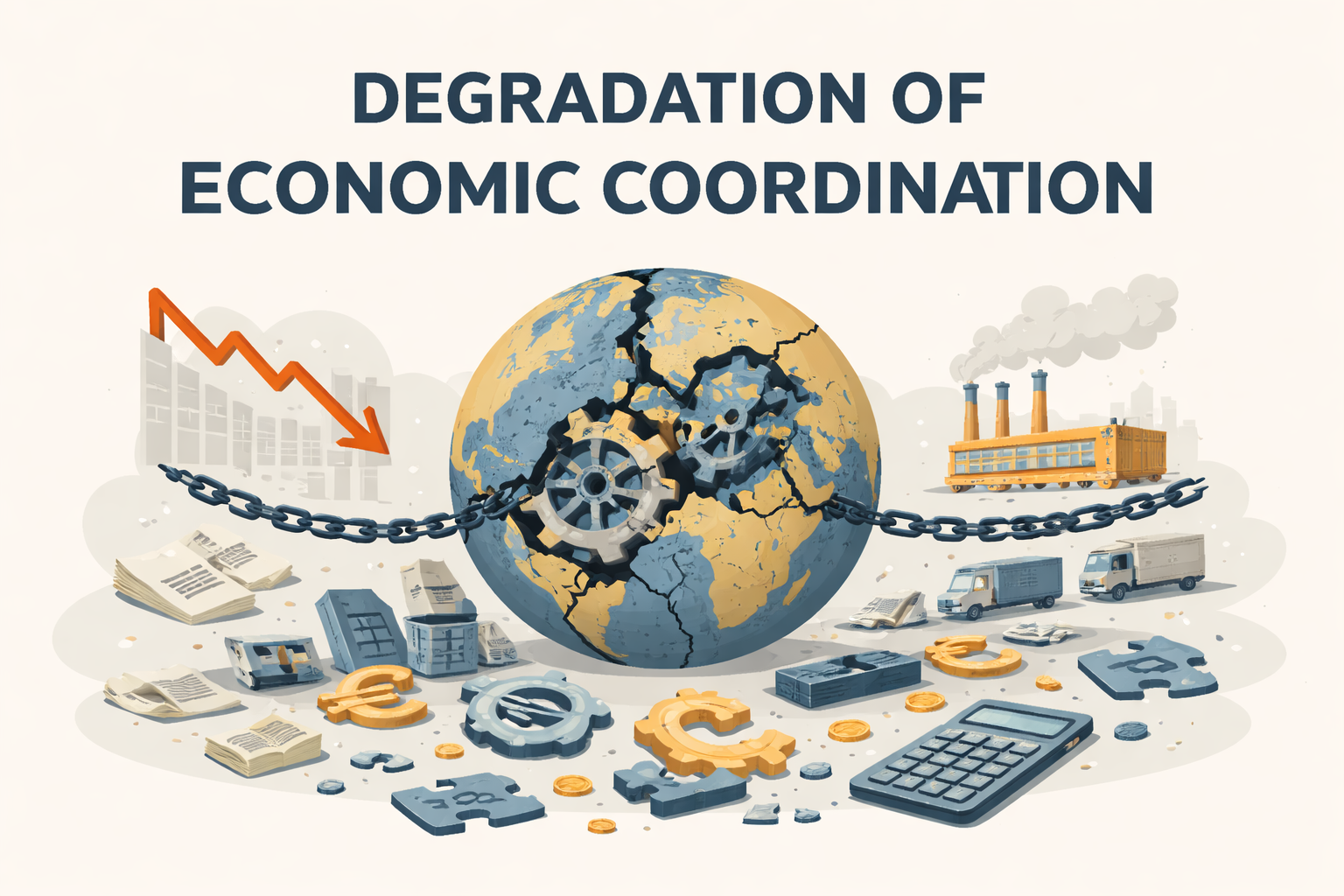
The Iran conflict has moved beyond the dynamics of an external shock. It now functions as a condition of managed instability in which strategic ambiguity, selective scarcity, and fragmented institutional responses systematically degrade the performance of economic and political systems.
The resulting impact is not characterized by systemic breakdown, but by a progressive erosion of coordination capacity, operational reliability, and decision coherence across interconnected systems.
Analytical framework (CORE)
Complexity
Interconnected systems exhibit nonlinear responses, where localized disruptions propagate unevenly and generate emergent constraints across sectors.
Orchestration
Coordination across actors, institutions, and jurisdictions becomes increasingly fragile as strategic ambiguity and conflicting incentives undermine alignment.
Risk
Uncertainty shifts from probabilistic risk to structural exposure, where second- and third-order effects dominate system behavior.
Enablement
Institutional and operational capacity becomes the limiting factor, as systems remain technically functional but increasingly difficult to operate effectively.
From shock to managed instability
The initial phase of the conflict could be interpreted as a classical geopolitical shock, primarily transmitted through energy markets and security channels.
This interpretation is no longer sufficient.
The system has transitioned into a state in which instability is not an unintended byproduct, but a sustained condition shaped by the interaction of military pressure, diplomatic signaling, and economic interdependence.
Strategic ambiguity plays a central role in this configuration. Key actors simultaneously pursue escalation and de-escalation, maintaining optionality while avoiding definitive commitments. This produces a system in which expectations cannot stabilize, and forward planning becomes structurally constrained.
Selective scarcity instead of systemic breakdown
Contrary to conventional crisis narratives, the conflict has not resulted in a uniform disruption of supply.
Instead, scarcity emerges selectively:
maritime routes are partially restricted rather than fully blocked
energy flows are redirected rather than halted
access to infrastructure becomes conditional rather than unavailable
This selective disruption creates uneven exposure across sectors and geographies. Some actors maintain access at higher cost, while others face temporary exclusion.
The result is not a collapse of supply chains, but a fragmentation of access conditions, increasing the complexity of coordination and allocation.
Operational adjustment as primary response
Organizations do not respond to this environment through strategic repositioning alone, but through continuous operational adjustment.
Examples include:
capacity reductions in energy-intensive sectors
rerouting of logistics and transport networks
short-term cost pass-through mechanisms
deferral or scaling of investment decisions
These responses indicate that systems remain functional, but only through active and ongoing intervention at the operational level.
The burden shifts from strategic planning to execution under constraint, increasing managerial complexity and reducing efficiency.
Fragmented policy responses and coordination limits
Policy responses across jurisdictions remain heterogeneous and, in many cases, internally inconsistent.
Governments and institutions simultaneously:
attempt to stabilize prices
introduce sector-specific relief measures
adjust regulatory frameworks under pressure
signal long-term structural transitions
These measures often address immediate pressures but do not resolve underlying coordination problems. Instead, they introduce additional layers of complexity, as actors must navigate overlapping and sometimes conflicting policy environments.
The conflict thus reinforces a structural condition in which systems are highly interconnected but insufficiently coordinated.
System degradation without collapse
The most distinctive feature of the current phase is the absence of systemic breakdown despite increasing stress.
Markets continue to clear. Supply chains continue to operate. Institutions continue to function.
However, they do so with:
higher costs
reduced predictability
lower coordination efficiency
increased dependence on continuous intervention
This condition can be described as systemic degradation. Performance declines incrementally, while the system remains formally intact.
Maintaining stability becomes more resource-intensive, and the margin for error narrows.
Concluding observation
The Iran conflict does not introduce a fundamentally new type of disruption. It makes existing structural limitations visible under conditions of sustained stress.
It reveals systems that are deeply interconnected yet operationally fragmented, where coordination capacity is insufficient to match the level of interdependence.
At the same time, it highlights that primary actors themselves operate without stable strategic end states, pursuing parallel and sometimes contradictory logics.
In this sense, the conflict is not best understood as a crisis event, but as a diagnostic condition. It exposes how contemporary economic and political systems function when stability is no longer given, but must be continuously produced under conditions of managed instability.
References
Geopolitics and conflict dynamics
New York Times (2026): Coverage of the Iran conflict, U.S. policy shifts, and escalation scenarios (March 25–April 1)
Neue Zürcher Zeitung (2026): Berichterstattung zu regionalen Dynamiken, einschließlich Golfstaaten, Stellvertreterakteuren und strategischen Implikationen
Handelsblatt (2026): Berichterstattung zu US-Strategie, NATO-Positionierung und europäischer Exponierung gegenüber dem Konflikt
Energy systems and macroeconomic transmission
New York Times (2026): Coverage on oil price dynamics, LNG flows, and global energy market disruptions
Handelsblatt (2026): „Iran-Krieg droht Weltwirtschaft zu bremsen – Fitch sieht zwei Risikofaktoren”
Neue Zürcher Zeitung (2026): Berichterstattung zu Rohstoffpreisübertragung und energiebedingten Inflationsdynamiken
Supply chains and industrial impact
Handelsblatt (2026): „Sprit, Aluminium, Einmalhandschuhe: Viele Rohstoffe und Vorprodukte werden knapp und teuer”
Handelsblatt (2026): Berichterstattung zu Luftfahrt, Logistikstörungen und steigenden Inputkosten
Neue Zürcher Zeitung (2026): Berichterstattung zu sektoralen Auswirkungen auf europäische Industrie und Lieferkettenanpassungen
Financial markets and system response
Handelsblatt (2026): Berichterstattung zu Aktienmarktreaktionen, Anlegerverhalten und Volatilität
New York Times (2026): Coverage on global financial market responses to geopolitical escalation
Neue Zürcher Zeitung (2026): Berichterstattung zum Verhalten der Kapitalmärkte unter geopolitischem Stress
Structural framing and interpretation
Author analysis
This note draws on continuous monitoring of real-time reporting and market developments between 25 March and 1 April 2026.