
From shock to structure: The Iran conflict and the limits of European economic coordination
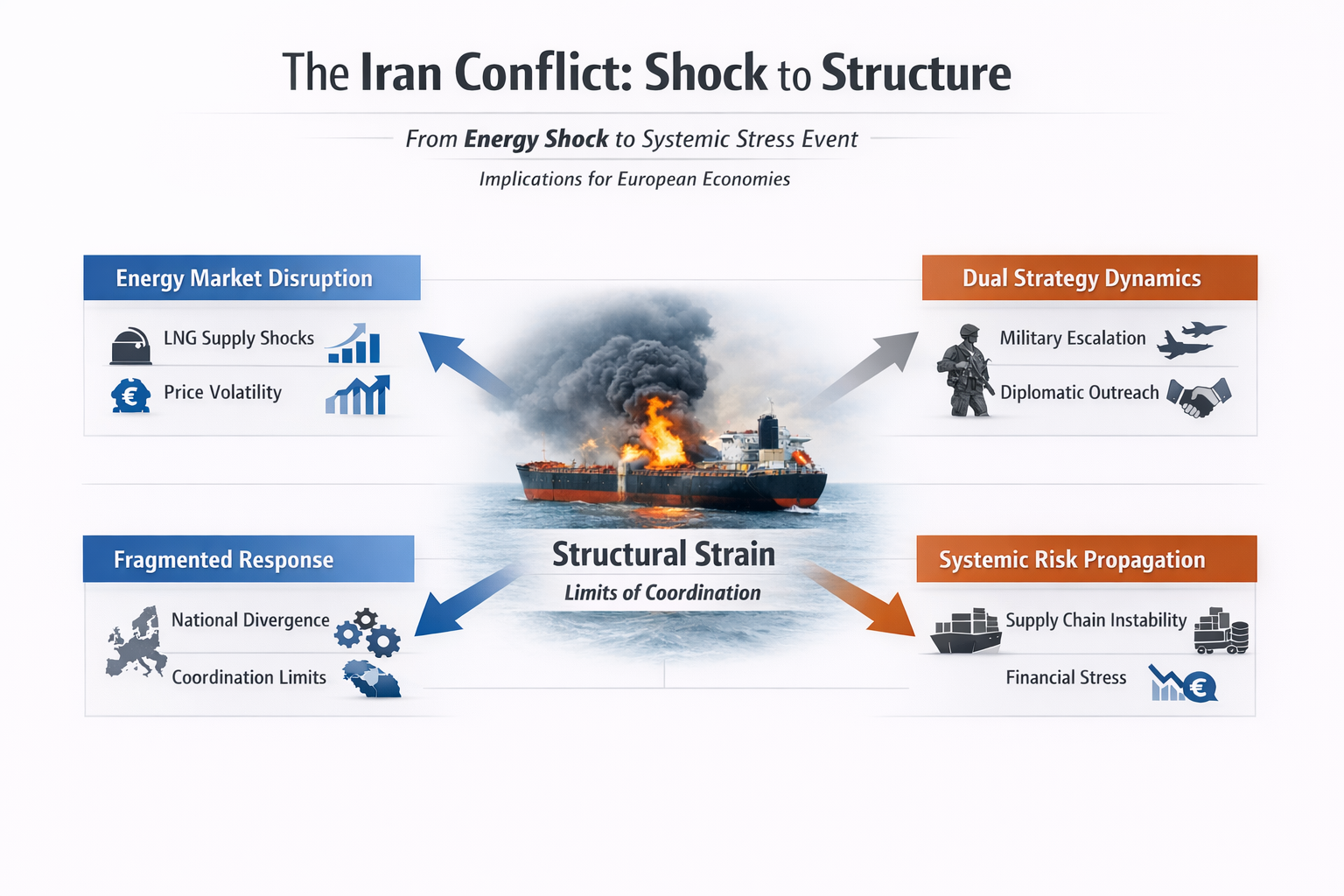
From energy shock to systemic stress event
Abstract
The current Iran conflict is commonly framed as an energy shock with implications for global markets. This framing, while directionally correct, understates the structural relevance of the event.
This research note interprets the conflict as a systemic stress event that exposes the limits of coordination, the fragility of interdependent systems, and the non-linear propagation of risk across European economies. Rather than focusing on market volatility, the analysis examines how structural conditions shape the ability of organizations and economic systems to respond under pressure.
The findings suggest that the primary effect of the conflict is not disruption in the conventional sense, but the exposure of latent constraints in coordination, decision-making, and system design.
Key Insights
The primary impact of the Iran conflict is not physical disruption, but the propagation of cost, uncertainty, and coordination constraints across interdependent systems.
European economies are structurally integrated but operationally distributed, limiting the ability to coordinate coherent responses under time pressure.
Risk emerges not as a singular event, but as a sequence of interacting effects across energy markets, supply chains, and financial systems.
Political and military actors pursue parallel and sometimes contradictory strategies, amplifying uncertainty for downstream economic systems.
Adaptation to past crises has increased system complexity without proportionally improving coordination capacity.
Core thesis
The Iran conflict does not primarily disrupt European economies through physical scarcity. It exposes the limits of coordination in a system that is structurally integrated but operationally distributed across heterogeneous actors.
The resulting impact is less a breakdown of supply and more a re-pricing of complexity, risk, and organizational constraint.
The conflict as a structural stress test
The analytical relevance of the Iran conflict lies in its function as an external stressor applied to a tightly coupled and interdependent economic system.
Initial effects are observable in energy markets, including disruptions to LNG infrastructure in the Gulf region and sharp increases in European gas prices.¹
At the same time, the strategic posture of key actors remains unstable. Recent developments indicate a simultaneous expansion of military capabilities and diplomatic initiatives, suggesting that escalation and de-escalation are pursued in parallel rather than sequentially.⁶⁷
A significant share of global oil and gas flows passes through a limited number of maritime chokepoints, making localized disruption structurally capable of generating system-wide effects.⁷
The system does not absorb the shock. It redistributes it.
Complexity without control
The dynamics observed following the escalation challenge the implicit assumption that economic systems remain governable under stress.
Rising energy prices interact with pre-existing structural conditions, including industrial energy dependence, constrained supply chain configurations, and rigid policy frameworks. These interactions produce feedback loops rather than stable adjustments.
Attempts to stabilize outcomes through pricing mechanisms, policy intervention, or short-term coordination do not eliminate volatility. They often shift it across domains.
The system exhibits complexity without effective control.
Europe’s orchestration deficit
The European response to the conflict reveals a structural limitation: coordination exists, but orchestration does not.
Member states respond according to national priorities, energy exposure, and fiscal capacity. The resulting actions are temporally misaligned and strategically inconsistent.
At the geopolitical level, the absence of a stable strategic end state among primary actors further complicates coordination. If escalation, force projection, and diplomatic outreach occur simultaneously, downstream systems inherit this ambiguity and cannot anchor expectations.⁶⁷
Supranational coordination mechanisms operate under constraints of institutional complexity, competing mandates, and procedural latency. As a result, they are structurally incapable of producing coherent, timely responses under conditions of rapid escalation.
The conflict therefore exposes not only economic vulnerability, but a deficit in the ability to orchestrate action across a heterogeneous system.
Asymmetry of exposure and response
The impact of the conflict is not evenly distributed, and neither is the capacity to respond.
Germany’s exposure is less defined by direct supply dependency and more by its structural reliance on energy-intensive industrial production.²
Austria, as a smaller and more open economy, exhibits faster transmission of cost increases into consumer prices and policy responses.
Switzerland’s position is shaped less by physical exposure and more by its integration into European financial, trading, and commodity systems.
At the European level, increasing reliance on global LNG markets introduces a structural exposure to external price formation, reducing the effectiveness of regional coordination.
What emerges is not a shared vulnerability, but a fragmented landscape of asymmetries.
Risk as systemic propagation
Risk does not materialize as a discrete event. It propagates through interconnected systems.
Energy price increases affect industrial cost structures, which influence pricing behavior and inflation dynamics across the euro area.⁴⁵
Each stage introduces additional uncertainty, forcing organizations to operate under increasingly constrained informational conditions.
Disruptions to shipping routes in the Strait of Hormuz and rising insurance costs further demonstrate how localized events extend into global logistics systems.³
The concentration of energy flows through narrow transit corridors reinforces the non-linear propagation of disruptions across global systems.⁷
The system does not experience a single shock. It experiences a sequence of interacting disturbances.
Enablement and structural constraint
The conflict raises a fundamental question: under what conditions can systems act coherently when exposed to non-linear and interdependent shocks?
Enablement is not determined by resource availability alone. It depends on structural characteristics, including flexibility, decision-making architectures, and the ability to coordinate across institutional boundaries.
European systems exhibit high levels of interdependence but limited adaptive capacity. Path dependencies, regulatory fragmentation, and institutional inertia constrain the range of feasible responses.
As a result, action is often reactive, localized, and temporally delayed.
The constraint is not informational. It is structural.
Concluding observation
The Iran conflict does not introduce a fundamentally new type of disruption. It makes existing structural limitations visible.
It reveals a system that is highly interconnected yet insufficiently coordinated, while also demonstrating that even primary actors operate without stable strategic end states and pursue contradictory logics simultaneously.
Historical experience has led to adaptation, but not to coherence. Adjustments to previous crises have increased the structural complexity of the system without proportionally increasing its capacity for coordination.
The structural importance of physical chokepoints such as the Strait of Hormuz illustrates how localized constraints can scale into global economic effects.
These dynamics are consistent with earlier analyses of geopolitical shock transmission and governance fragmentation, but extend them by highlighting how such conditions are ultimately reflected in the pricing of complexity, risk, and constraint.
In this sense, the conflict is less a crisis than a diagnostic event, exposing the limits of orchestration in contemporary economic systems.
References
Handelsblatt (March 2026): LNG disruptions and European gas price increases
Handelsblatt (March 2026): Germany’s macroeconomic exposure to energy price shocks
Handelsblatt (March 2026): Shipping disruptions and insurance cost increases (Hormuz)
Reuters (March 2026): Euro area slowdown, rising input costs, inflation pressures
International Energy Agency / European Central Bank (2026): Energy and macroeconomic exposure assessments
Neue Zürcher Zeitung (25 March 2026): Strategic recalibration and diplomatic optionality in US-Iran relations
The New York Times (25 March 2026): Analysis of global energy flows and chokepoint dependencies in the Strait of Hormuz